
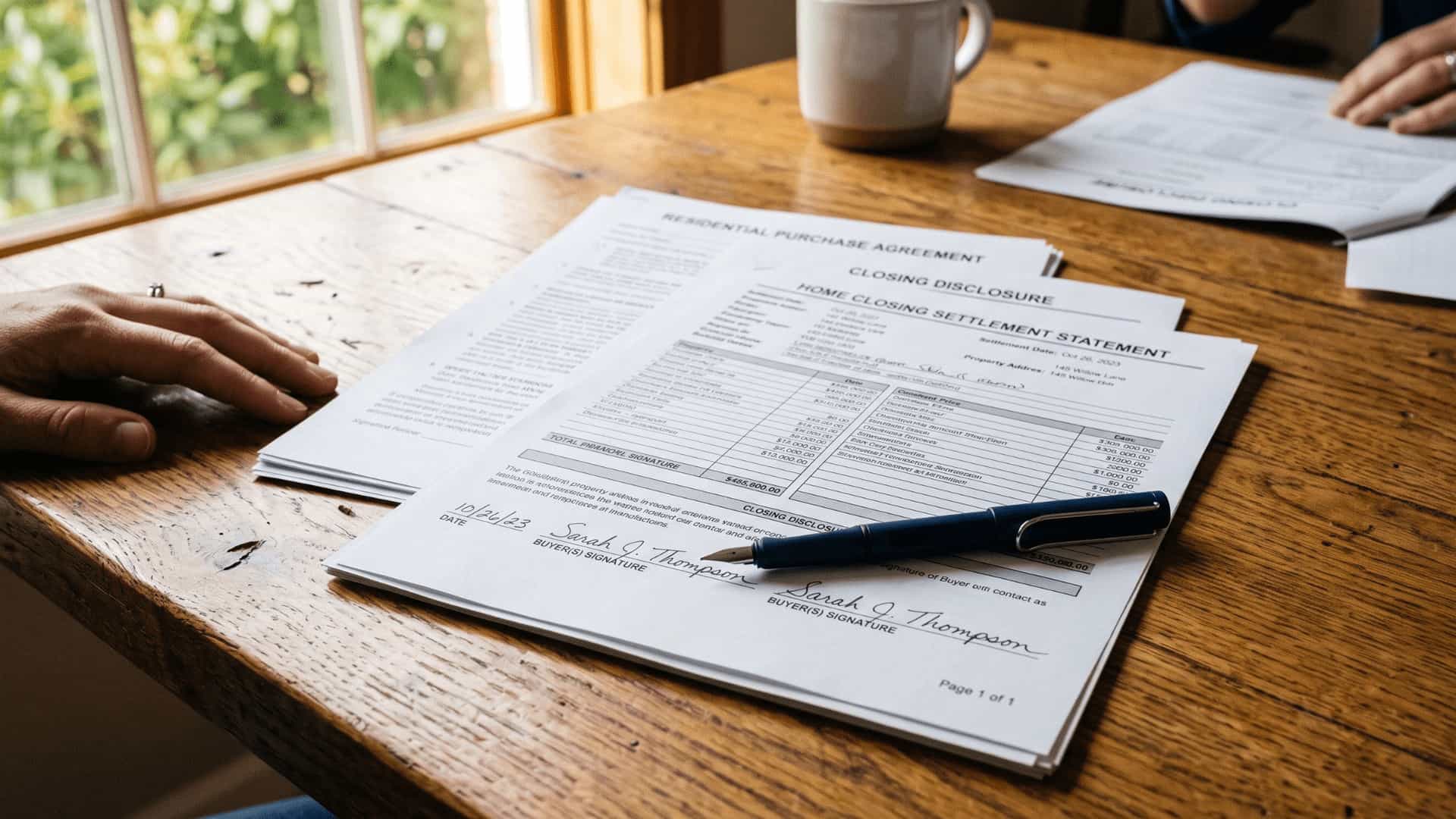
Selling your home to a cash buyer sounds simple on the surface. But once the paperwork starts, one question surfaces fast: who actually pays closing costs?
It shifts depending on who’s buying, how the deal is structured, and which state your property sits in. Getting this wrong can quietly cost you thousands of dollars you never planned to lose
Closing costs in a cash sale
When you sell to a legitimate institutional cash buyer or investor, they typically absorb 100% of standard closing costs including escrow fees, title search, transfer taxes, and notary charges as a core part of their offer. In a standard peer-to-peer cash sale between private parties, closing costs follow local county customs, usually split 50/50 or negotiated contractually.
Either way, certain seller obligations your existing mortgage payoff, property tax proration, and any liens on the title are always your responsibility, regardless of who’s buying.
What are closing costs in a real estate transaction?
Closing costs are the collection of fees, taxes, insurance premiums, and prorated adjustments required to legally transfer ownership of a property. They’re not a single charge they’re a stack of line items, and each one has a responsible party.
In a conventional financed transaction, the buyer’s costs typically run 2% to 5% of the loan amount, covering mortgage origination fees, underwriting charges, credit reports, flood zone certifications, independent appraisals, and prepaid escrow reserves for taxes and insurance.
The seller carries a heavier burden. Average closing costs for sellers historically land between 6% and 10% of the final sale price. On a $362,000 home near the current U.S. median that translates to $28,960 to $36,200 out of pocket before you see a single dollar of equity.
The bulk of that percentage goes straight to real estate agent commissions, which average 5% to 6% of the sale price for both sides combined.
Federal disclosure rules: what changes in a cash deal
Under RESPA and the integrated TILA-RESPA rule (TRID), any lender must issue a Loan Estimate at the start of the process and a final Closing Disclosure at least three business days before closing giving buyers a federally mandated window to review every charge.
Cash transactions have no lender. That means no Loan Estimate, no federally mandated closing disclosure. Instead, the closing is settled through a standardized ALTA settlement statement or a HUD-1 cash transaction form.
Traditional seller closing costs vs cash sale side by side
Compares the real cost distribution for a $400,000 property, contrasting a traditional financed sale against a direct cash investor purchase where the buyer assumes all closing costs.
| Cost Line Item | Traditional Sale (Financed) | Cash Sale to Investor (Cost Absorption Model) | Why the Difference Exists |
|---|---|---|---|
| Agent Commissions (5.5% combined) | $22,000 | $0 | No listing or buyer’s agent involved |
| Owner’s Title Insurance (0.5%) | $2,000 | $0 (assumed by buyer) | Negotiated to accelerate the sale |
| Escrow / Settlement Fee | $1,200 | $0 (assumed by buyer) | Investor absorbs the operational charge |
| Transfer Taxes (avg.) | $2,000 | $0 (assumed by buyer) | Tax liability transferred to buyer |
| Appraisal Fee | $0 (buyer-paid) | $0 (not required) | No mortgage = no bank appraisal |
| Notary, Recording & Courier | $1,000 | $0 (assumed by buyer) | Streamlined digital processing |
| Buyer Concessions / Repair Credits | $5,000 | $0 | As-is sale, no inspection contingencies |
| Total Seller Closing Costs | $33,600 (8.4% of price) | $0 net to seller | Buyer assumes costs as the value trade |
The math is clear. A cash investor absorbing your closing costs isn’t doing you a favor out of generosity it’s their competitive advantage. They trade zero closing costs for a lower purchase price. Your job is to calculate whether the net proceeds still work for your situation.
Title insurance and search fees: Who pays, and why it varies by state
Unlike standard insurance products focused on future risks, title insurance is retroactive. Underwriters spend roughly 90% of their premiums on upfront title searches and investigations, maintaining a relatively low claims rate compared to other insurance categories.
According to resources from the American Land Title Association (ALTA), the Owner’s Title Insurance policy typically runs 0.5% to 1% of the purchase price, paid as a one-time premium at closing.
Who pays it depends almost entirely on where your property is located:
- West Coast custom: The seller typically pays the owner’s policy to deliver a clean, insurable title to the buyer.
- East Coast custom: The buyer usually purchases their own owner’s policy independently.
- States with promulgated rates: In Florida, New Mexico, and Texas, title insurance rates are set by state regulators no price competition between companies, but simultaneous issue discounts apply when a lender’s policy is purchased alongside the owner’s policy.
Escrow fees and transfer taxes
Escrow Fees
Escrow fees, sometimes called settlement fees, compensate the neutral closing agent (a title company, legal firm, or independent fiduciary) for holding purchase funds, managing document execution, and recording the deed transfer.
These fees typically run $1,000 to $2,000, scaling with the transaction’s complexity. The standard split is 50/50 between buyer and seller but local custom overrides that default constantly.
Transfer taxes: The widest variable in real estate closings
Government transfer taxes are where geographic disparity hits hardest.
- 15 states, including Texas (Houston, Dallas, Austin): No transfer tax whatsoever prohibited by state law.
- Colorado (Denver): Moderate transfer tax averaging around $597 on a median-priced home.
- California, New York, Delaware, Washington: Progressive rates plus municipal surcharges. In Seattle, transfer tax on a median sale can exceed $11,058. In San Francisco, combined state and city transfer taxes routinely hit 2% of the gross sale price.
Does a cash buyer usually cover all closing costs?
In a private peer-to-peer cash sale say, a neighbor or acquaintance buying your home without a mortgage the closing cost split follows local county custom or whatever the purchase contract specifies. No automatic absorption, no investor incentive.
The trade-off is direct: they pay your closing costs, and you accept a purchase price below fair market value.
- Homes needing significant renovation: offers typically land at 50% to 70% of current market value
- Move-in-ready or lightly distressed homes: offers often range from 70% to 80% of the projected After-Repair Value (ARV), after deducting estimated rehab costs and the investor’s profit margin
What costs are always the Seller’s responsibility?
Before you celebrate a «zero closing costs» deal, understand the non-negotiables. These obligations never transfer to the buyer, regardless of how the deal is structured:
- Existing mortgage payoff: Your lender gets paid out of closing proceeds before you see a dollar. If you owe $280,000 on a home sold for $340,000, your equity is the difference not the full sale price.
- Property tax proration: You owe taxes for every day of the year you owned the home. That amount is calculated at closing and deducted from your proceeds, period.
- HOA dues and special assessments: Outstanding balances or transfer fees owed to your homeowners association must be cleared before the title can transfer cleanly.
- Federal and state tax liens: IRS liens, state income tax levies, mechanic’s liens, and child support judgments recorded against the property are non-negotiable. They must be satisfied at closing no investor can waive them on your behalf.
- Outstanding judgments on title: Any court judgment attached to your property becomes a lien on the real estate. It must be resolved before a clean deed can transfer.
Red Flags: When an investor tries to pass fees back to the seller
The tactic that should concern you most is what practitioners call the last-minute squeeze. Here’s how it plays out:
How to vet a cash buyer before signing anything
Use this checklist before executing any purchase agreement:
- Demand Proof of Funds within 24 hours. A legitimate cash buyer produces a recent bank statement or an institutional verification letter showing liquid funds sufficient to close. Vague responses or delay are disqualifying.
- Require a real Earnest Money Deposit (EMD). A serious buyer commits roughly 3% of the purchase price, deposited into a neutral title company escrow account within 48 hours of signing. An EMD of $1,000 or less than 1% signals a buyer minimizing exposure because they’re unsure they can close.
- Strike «and/or assigns» from the contract. This phrase allows the buyer to transfer their contractual rights to a third party without your knowledge or consent. It’s the structural hallmark of wholesale flipping. If they refuse to remove it, walk away.
- Reject any upfront fees. Legitimate investors make their money on renovation and resale margins not on fees charged to the seller. Any request for inspection fees, processing charges, or «administrative costs» before closing is a fraud indicator.
- Verify the escrow company independently. If the buyer insists on using an unfamiliar closing agent, confirm that agent’s physical existence and active state license independently. Or insist on a title company with a verifiable local track record.
Full breakdown: out of pocket expenses in a cash transaction
| Expense / Obligation | Traditional (Financed) | Standard Cash Sale (No Absorption) | Legitimate Investor (Cost Absorption) |
|---|---|---|---|
| Brokerage Commissions | Seller pays 5–6% | Seller pays 5–6% if agent involved | Seller pays $0 direct purchase |
| Escrow & Deed Recording | Seller pays ~50% split | Subject to county custom or 50/50 split | Seller pays $0 investor covers fully |
| Property Tax Proration | Seller pays (obligatory) | Seller pays (obligatory) | Seller pays (obligatory, always) |
| HOA Dues & Assessments | Seller pays to clear title | Seller pays to clear title | Seller pays to clear title |
| Mortgage Payoff (Existing) | Seller pays from proceeds | Seller pays from proceeds | Seller pays from proceeds |
| Federal / Judicial Liens | Seller pays to clear title | Seller pays to clear title | Seller pays to clear title |
| Home & Pest Inspection | Seller pays if contractually required | Seller pays $0 buyer typically funds own report | Seller pays $0 investor does internal walkthrough |
| Notary & Closing Documents | Seller pays ~$100–$250 | Seller pays ~$100–$250 | Seller pays $0 investor funds notary process |
The pattern is consistent: operational transaction fees (the ones tied to the mechanics of the transfer) are what legitimate investors absorb. Pre-existing financial obligations tied to your ownership history are always yours to resolve.
How to calculate your real net proceeds before deciding
Comparing offers without a net proceeds calculation is like comparing restaurant bills without reading the full check. Here’s the framework:
- Start with the gross offer price. This is the number the buyer puts in front of you. It means nothing on its own.
- Subtract what you owe. Add up your mortgage payoff, outstanding HOA balances, any liens, and your prorated property tax bill. This is your fixed cost floor it doesn’t change regardless of the buyer.
- In a traditional sale, subtract transaction costs. Agent commissions (5–5.5%), your share of escrow, transfer taxes in your state, any repair concessions from inspection, and your carrying costs for the months the home sits on market. These add up fast commonly $40,000 to $60,000 on a $400,000 home when all factors compound.
- In a cash investor sale, subtract the price discount. Most offers land 15% to 30% below fair market value. But subtract nothing for commissions, repairs, escrow, or carrying costs those are gone.
- Compare the two net figures not the two gross prices. The cash offer’s headline number will almost always look lower. Its net proceeds figure is often remarkably close to and sometimes higher than what a traditional sale actually delivers after friction costs.
If you want to run this comparison in detail, our guide to comparing traditional listings vs. cash offers walks through a $400,000 case study showing the full side-by-side math.
Closing cost depends the location in EEUU
Your state and county will determine more about your closing cost structure than any national average ever will.
No transfer tax states (including Texas): Your effective closing cost burden as a seller drops significantly. Cash investors in these markets can offer stronger net prices because their own cost absorption is lighter.
High-tax coastal markets (California, New York, Washington): Transfer taxes, mansion taxes, and city-level surcharges can add 1% to 3% to the transaction. A cash investor absorbing those costs is delivering a tangible, calculable benefit not just a sales pitch.
States with promulgated title rates (Florida, Texas, New Mexico): Title insurance pricing is locked by regulators. You won't find a better rate by shopping around, but you will find simultaneous issue discounts if a lender's policy is also being purchased irrelevant in a pure cash deal, but worth knowing.
California escrow county quirks: If your property is in Alameda or Contra Costa County, expect the buyer to pay 100% of escrow under local custom. If you're in LA or San Diego, expect an even split. Always confirm with your chosen title company before signing.