
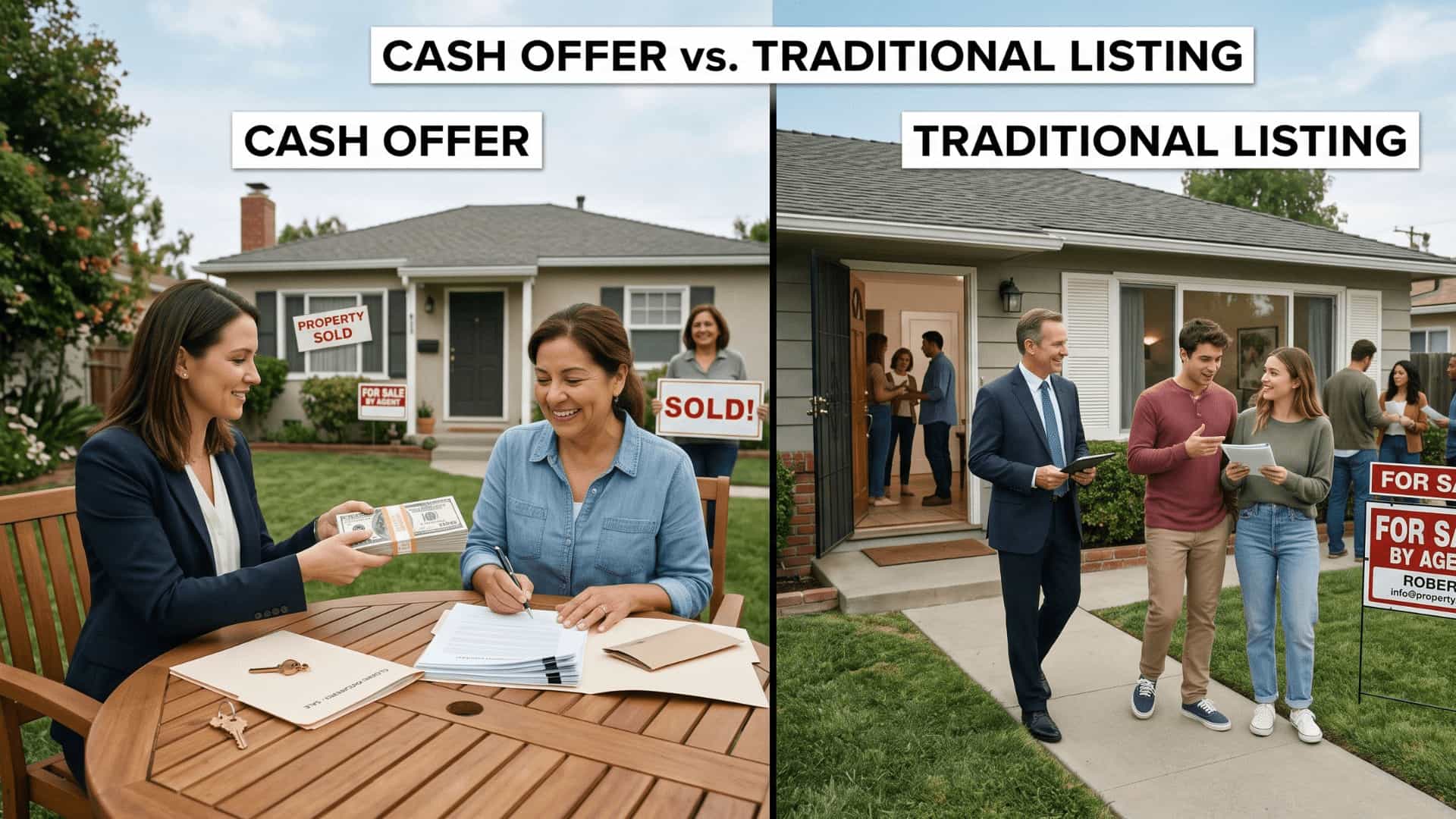
The core difference in cash offer vs traditional sale lies in the buyer’s risk profile, the transactional compensation channel, and the dependence on financial intermediaries under complex macroeconomic conditions
The decision to opt for direct liquidity versus exposure to the secondary market conceptualized as selling house for cash vs traditional introduces the seller to an ecosystem composed of three well-defined cash buyer profiles:
- Digital acquisition platforms (iBuyers): Technology operators that acquire homes through automated valuation algorithms, charging a service fee rather than conventional commissions.
- Institutional investors and renovation firms: Consortiums that acquire physically obsolete assets to renovate and reintroduce to market, operating under mass schemes such as the We Buy Ugly Houses franchise model.
- Retail buyers with their own liquidity: Individuals purchasing to occupy the home, using consolidated capital from a prior sale or inherited wealth, enabling them to compete without loan contingencies.
The core difference: cash buyers vs. traditional Market
| Buyer Category | Avg. % of As-Is Value | Offer Mechanism & Margin | Target Asset Type |
|---|---|---|---|
| Contract Intermediary (Wholesaler) | 55%–65% | Opens with aggressive offers to assign purchase rights to a third party via assignment fees. | Abandoned properties or those with serious legal issues. |
| Professional Investor / iBuyer | 60%–75% of ARV | Applies the 70% ARV rule, subtracting estimated remodeling and corporate holding costs. | Homes requiring structural or aesthetic upgrades. |
| Retail Cash Buyer | 76%–84% of market value | Acquires the property using accumulated liquidity to avoid direct mortgage competition. | Move-in ready homes in stable locations. |
| Traditional Financed Buyer | 95%–100% of appraisal value | Depends on conventional or government-backed mortgage (FHA) approval. | Homes in optimal physical and aesthetic condition. |
Why do sellers prefer cash offers? (The benefits)
The benefits of a cash offer on a house requires evaluating contractual certainty and optimized operational timelines.
No appraisal and financing vontingencies
In a standard retail sale, the agreement is subject to financing contingency and formal property appraisal. If the buyer’s bank-designated appraiser determines that the property’s value is lower than the agreed purchase price, an appraisal gap occurs.
The seller is forced to renegotiate the price downward, the buyer must contribute unexpected funds to cover the deficit, or the contract is rescinded entirely returning the property to market with the stigma of a failed transaction.
| ⚡ Key insight: Approximately 5–7% of traditional sales fall through each month due to financing or appraisal contingencies, per NAR data. A cash offer eliminates this risk entirely. |
Accelerated closing timelines
The time variable directly influences the preservation of the owner’s net worth. While conventional financed transactions take an average of 45–60 days to close due to bank underwriting risk analysis cycles, the closing process with a direct equity buyer typically completes within 7–28 days, with an operational average of two weeks.
This speed is critical in situations of urgent job relocation, divorces, complex estate liquidations, or for owners needing to mitigate imminent foreclosures. In the latter case, a delay in the traditional sale can result in total loss of the asset.
The financial reality: comparing net proceeds
To resolve whether a cash offer is better for a seller, a complete audit of friction costs that reduce gross sale value in a traditional process is essential. Many sellers make the mistake of being seduced by a high nominal listing price without deducting the multiple layers of commissions, repairs, concessions, and accumulated carrying costs during the exposure period.
The cost structure that diminishes net equity in a traditional transaction encompasses the following variables:
- Brokerage commissions: Following the August 2024 NAR antitrust settlement, rules changed significantly. Advertising buyer agent compensation in the MLS is prohibited; all commissions must be negotiated explicitly. Despite this reform, the combined average brokerage fee remains approximately 5.70% (2.88% for listing agent, 2.82% for buyer’s agent).
- Preparation and structural adequacy costs: Retail buyers require move-in-ready homes. The national average cost for cosmetic repairs, painting, and professional staging before listing is $14,163. Opting for selling your property as-is to a direct investor neutralizes this initial capital outlay.
- Monthly carrying costs: Maintaining an asset on market is not free. During months when the property is active, under negotiation, or awaiting the buyer’s mortgage close, the seller must continue paying monthly mortgage payments, prorated property taxes, home insurance, utilities, and HOA fees.
- Technical inspection concessions: Detailed physical inspections contracted by traditional buyers typically reveal defects that lead to last-minute discount requests or closing credits averaging 1%–1.5% of the agreed value.
Agent commissions vs cash discounts
The following net balance model illustrates the real equity difference when comparing a traditional listing and a direct cash offer for a median single-family home with a fair market value of $400,000. The traditional scenario assumes an estimated exposure, negotiation, and mortgage close time of four months with monthly operating costs of $2,500, versus a direct cash offer with a 15% nominal discount closing in 14 days.
| Cost Breakdown | Route 1: Open Market Listing (Traditional) | Route 2: Direct Cash Offer |
|---|---|---|
| Gross Sale Price / Offer | $400,000.00(100% of market value) | $340,000.00(15% nominal discount) |
| Agent Fees (5.70% avg) | −$22,800.00 | $0.00(Direct sale, no intermediaries) |
| Seller Closing Costs (2.5%) | −$10,000.00(Title insurance, recording, escrow) | $0.00(Fully assumed by investor) |
| Repairs & Staging Investment | −$12,000.00(Aesthetic property preparation) | $0.00(As-is transaction) |
| Carrying Costs (monthly) | −$10,000.00(4 months × $2,500/mo) | −$1,250.00(0.5 months for fast close) |
| Inspection Credits / Concessions | −$5,000.00(Repair adjustment agreed) | $0.00(No punitive inspection clauses) |
| Total Transaction Deductions | $59,800.00 | $1,250.00 |
| NET PROCEEDS (Equity Retained) | $340,200.00(85.05% of gross nominal value) | $338,750.00(84.69% of gross nominal value) |
| Net Equity Difference | Reference Point | $1,450.00(Only 0.36% of asset value) |
When to accept a cash offer over a market listing
Optimizing residential wealth is not governed by absolute dogmas; it depends on the correlation of forces between macroeconomic health, the physical condition of the property, and the owner’s liquidity needs.
Optimal conditions for a traditional open-market listing
- Strong physical asset condition: The property fully meets habitability standards and requires no urgent structural investments that would compromise conventional or government-backed loan eligibility.
- High-demand macroeconomic environments: Areas where chronic housing supply shortages a phenomenon the Federal Reserve attributes to the historic slowdown in residential construction since the 1960s–70s generate highly dynamic markets that push prices upward and accelerate financed buyer absorption.
- Capital and time sufficiency: The seller can financially sustain monthly carrying costs without compromising personal cash flow, allowing them to wait for the best retail buyer.
Optimal conditions for a direct cash offer
- Protection against physical devaluation: Assets requiring deep renovation to reach their After Repair Value (ARV). Rather than taking on complex renovation loans (such as the FHA 203k program), the owner monetizes the property as-is, transferring construction risk to the investor.
- Legal and financial urgency (Disposition Alternatives): In situations of chronic non-payment, owners may be exposed to the devastating consequences of conventional foreclosure. Under HUD Selling Guides, rapid disposition tools such as direct sale before adjudication, or structured short-sale or deed-in-lieu of foreclosure schemes allow for mitigation of patrimonial damage and rapid debt settlement.
- Interest rate uncertainty and market volatility: When financing costs for conventional buyers rise to historic levels relative to median family income, the probability of financed contract falls increases dramatically. In these credit contraction circumstances, securing a firm cash closing price acts as a defensive mechanism to protect accumulated equity against downward market corrections.