

If you’ve ever Googled «we buy houses» after a difficult life event a divorce, an inherited property, a looming foreclosure you’ve already seen how crowded and confusing this space is. Yard signs, cold text messages, local operators promising «cash in 7 days.» And somewhere in the middle of all that noise sits WeBuyHouses.com, a nationally recognized corporate brand that most homeowners can’t immediately distinguish from the informal investor down the street
This review cuts through that confusion. We audited the company’s corporate structure, its investor vetting process, its offer math, and its real-world customer reputation so you don’t walk into a negotiation blind.
What is WeBuyHouses.com?
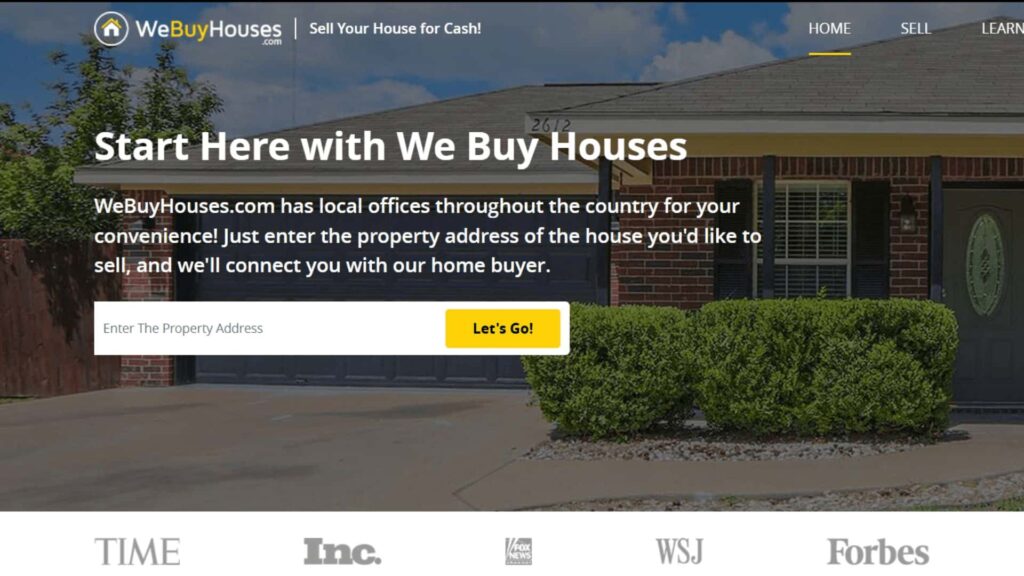
WeBuyHouses.com is a legitimate, established corporate brand, not a scam, and operating under a structured national licensing network. Offers typically land between 50% and 70% of your home’s current fair market value, which is the trade-off for speed, certainty, and a zero-repair sale.
Tegistered national trademark founded in 1997 by entrepreneur Jeremy Brandt and managed under the corporate firm WBH Marketing, Inc., headquartered in Grapevine, Texas.
Failing to make this distinction is how homeowners end up comparing apples to oranges or worse, attributing a bad experience with a random local operator to the brand as a whole, and vice versa.
How the Licensing Model Works
WeBuyHouses.com does not operate as a traditional franchise. Instead, it runs on a territorial licensing model that gives pre-qualified local real estate investors the exclusive right to use the brand name and receive platform-generated leads in a defined geographic zone.
This structure is fundamentally different from the HomeVestors franchise model, which requires franchisees to make massive upfront capital commitments. Here’s the direct comparison:
| Operating Parameter | Franchise Model (e.g., HomeVestors) | License Model (WeBuyHouses.com) |
|---|---|---|
| Required Initial Investment | $109,000 – $461,250 | $20,000 – $50,000 (one-time license fee) |
| Liquid Capital Requirement | Minimum $100,000 | No corporate minimum |
| Franchise Fees | Fixed $50,000 fee | Included in initial license |
| Monthly Fee Structure | Transaction royalties + shared ad costs | Flat monthly fee (low thousands) |
| Profit Sharing | Must report and share margins | Investor keeps 100% of profits |
| Operational Autonomy | Strict corporate oversight on appraisals | Full freedom to set offers and choose vendors |
What this means for you as a seller: Because local licensees operate independently and keep all their profits, the corporate office in Grapevine does not control or even see the price they offer you. The brand provides SEO infrastructure, technology, and lead generation. The actual deal is entirely between you and your local investor.
How the National Network Vets Local Real Estate Investors
The core vulnerability of any decentralized network is the quality of its members. WeBuyHouses.com is aware of this, and founder Jeremy Brandt has built an admissions protocol designed to filter out novice investors chasing get-rich-quick schemes or those who just came out of an informal investing seminar.
To be admitted to the official WeBuyHouses.com network, a local investor must meet these minimum standards:
- Proven Transaction History: The applicant must demonstrate they are actively closing 6 to 10 real estate deals per year before they can even apply for a license.
- Verified Closing Capacity: The company audits the investor’s liquidity to confirm they have personal funds or institutional credit lines in place to close in cash o financing contingencies.
- Signed Ethics Commitment: Every operator must subscribe to an explicit ethics standard. The corporate office retains the contractual right to unilaterally revoke a license if the investor engages in deceptive practices, commercial harassment, or contract breaches.
This is a meaningfully higher bar than the typical local «we buy houses» operator you’d find on a yard sign.
The Offer Evaluation: What Percentage of ARV Do They Pay?
Local licensees operate primarily as fix-and-flip investors. Every offer they make must account for acquisition costs, renovation, financing or holding costs, and profit margin. The industry-standard formula they use is the 70% ARV Rule:
Real-Dollar Comparison: Cash Sale vs. Traditional Listing
To make this concrete, here’s what a $300,000 home actually yields through each channel:
| Financial Parameter | Traditional Sale (Agent) | Direct Cash Sale (WeBuyHouses.com) |
|---|---|---|
| Nominal Sale Price | $300,000 (100% market value) | ~$210,000 (70% of estimated ARV) |
| Agent Commissions | 5%–6% ($15,000–$18,000) | $0 direct transaction |
| Closing & Title Costs | 2%–5% ($6,000–$15,000) | $0 absorbed by buyer |
| Prep, Staging & Cleaning | 1%–2% ($3,000–$6,000) | $0 |
| Pre-Sale Repairs | Variable (seller’s cost) | $0 sold strictly as-is |
| Average Time to Close | 30–90 days | 7–21 days |
| Estimated Net to Seller | $261,000–$276,000 | $210,000 |
A cash sale through this network costs you real equity roughly $51,000 to $66,000 in this example. That gap is the price of speed, simplicity, and certainty.
WeBuyHouses.com Reviews and Market Reputation
At the national brand level, the company aggregates to roughly 4.7 out of 5 stars across Google and regional review profiles. At the corporate entity level, parent company WBH Marketing, Inc. maintains a historical A+ rating with the Better Business Bureau, built on its longevity and low volume of direct corporate complaints.
However: The corporate headquarters in Grapevine does not hold active BBB accreditation. That accreditation decision sits with individual local licensees, creating substantial variation in regional compliance profiles. Before relying on any BBB rating, verify it belongs to your specific local investor, not the national brand.
For a broader look at how this company stacks up in the market, our investors that buy houses for cash comparison guide breaks down eight competing networks side by side.
What Satisfied Sellers Consistently Praise
When the local operator is ethical, reviews are enthusiastic. Recurring themes include:
- Speed in crisis situations: Closings completed in as little as one to two weeks during intestate estate settlements, complex divorces, and imminent foreclosures where timing is everything.
- True as-is acceptance: Properties sold with debris accumulation, non-functioning systems, damaged fixtures, and even occupied by difficult tenants no required cleanouts or repairs.
- Zero-friction process: No open houses, no mortgage contingencies, no buyer walk-throughs falling through at the last moment.
Documented Complaints and Red-Flag Tactics
The negative reviews expose patterns that every seller in this market should recognize before sitting down to negotiate:
1. Unsolicited Contact (Spam Calls and Texts) A significant volume of complaints describes automated dialing systems and mass SMS campaigns targeting homeowners whose properties are not listed for sale, in apparent violation of Do Not Call registry protections.
2. Contract Re-Trading This is the most financially damaging tactic in the industry. The investor makes an attractive opening offer, locks the seller into a purchase agreement, then returns during the inspection period with inflated repair estimates to justify a last-minute price reduction. By that point, the seller is emotionally committed and often running out of time exactly the vulnerability the tactic exploits.
3. Misrepresentation of Intended Use In high-demand markets like Arizona, documented complaints describe investors who justified lowball offers by claiming the property needed extensive renovations «for a young family.» Sellers later discovered the home was placed on the rental market weeks after closing with only cosmetic touch-ups.
4. Covert Wholesaling (Unauthorized Contract Assignment) Some licensees act as unlicensed intermediaries without the capital to actually buy your home. They tie up your property with a purchase contract, then attempt to sell that contract to a real investor for a fee. If they can’t find a buyer before the deadline, they cancel using the contract’s inspection clauses leaving you stranded. This is one of the most common predatory real estate tactics in the off-market space.
How to Verify Your Local WeBuyHouses.com Representative
The decentralized structure of this network puts the burden of due diligence squarely on you. Here’s a non-negotiable verification protocol before you sign anything:
Step 1: Demand Written Proof of Funds
A legitimate cash buyer can produce a recent bank certification letter in the name of the entity signing your contract, proving liquid funds sufficient to cover the full purchase price. If they offer excuses pending credit line approvals, private lender pre-approvals, or vague «partner» arrangements walk away
Step 2: Prohibit Contract Assignment
Insert a clause explicitly prohibiting the transfer of your purchase contract to any third party without your express written consent. A legitimate investor who plans to buy your home directly will have no objection to this. An intermediary trying to wholesale your property will resist it.
Step 3: Scrutinize the Earnest Money Deposit
Predatory operators consistently propose deposits of $0 to $500 or structure the deposit so it stays in their control until closing. A secure transaction requires:
- A minimum earnest money deposit of 1%–2% of the purchase price
- Funds held in escrow by an independent title company or real estate attorney
- Clear contractual language making the deposit non-refundable to the buyer if they cancel without legal cause
Step 4: Know Your Federal Rights
The Federal Trade Commission provides critical consumer protections for homeowners navigating complex equity transactions. Under the FTC’s Home Equity Shield guidance and the FTC Cooling-Off Rule, you may have an automatic 3-business-day right to cancel any contract signed somewhere other than the buyer’s permanent place of business with no financial penalties. Review these rights before you sign, not after.
The 10 Best Zones for WeBuyHouses.com Activity
Based on transaction volume, investor quality scores, and consistency of buyer reviews, these are the ten most active and reliable markets in the WeBuyHouses.com national network:
1. Dallas–Fort Worth Metro (Texas)
The corporate home base. Highest historical transaction concentration, with average close times under 10 days, supported by a dense ecosystem of title companies and inspectors.
2. Greater Memphis Region (Tennessee)
A critical market for low-cost and distressed property acquisition. Local licensees specialize in absorbing inherited property portfolios with serious structural backlogs.
3. Columbus Metro Area (Ohio)
One of the network’s strongest performers for digital reputation and local BBB accreditations. Operators here frequently offer post-closing occupancy windows, letting sellers coordinate their move without rushing.
4. Richmond and Fredericksburg Corridor (Virginia)
Strict legal compliance environment. Licensees are required to maintain active state professional licenses, providing a dependable channel for historic properties and larger residential parcels.
5. Jackson and Brandon Area (Mississippi)
High-demand market for properties carrying tax liens or foreclosure risk. Local operators are recognized for absorbing full debt remediation costs at title closing.
6. Florida Gulf Coast and Panhandle (Florida)
Specialized in storm-damaged, aging condominiums, and vacation properties. Investors buy without habitability repair requirements critical in hurricane-prone zones.
7. Denver Metro and Brighton (Colorado)
Premium price points require precise ARV analysis. Investors in this market compete aggressively, sometimes offering pre-signing cash advances to accelerate commitment.
8. Las Vegas Metro (Nevada)
High-volume, high-velocity market. Licensees acquire residential properties at speed to supply consistent inventory for the short- and medium-term rental sector.
9. Phoenix and the Valley of the Sun (Arizona)
One of the largest resale markets in the network. Proceed with heightened scrutiny here Arizona has the highest documented rate of inflated repair estimate complaints in the system.
10. Hartford and Glastonbury Region (Connecticut)
Old housing stock with high deferred maintenance costs and outdated heating systems. Local investors facilitate fast exits on properties that wouldn’t qualify for traditional mortgage financing.