
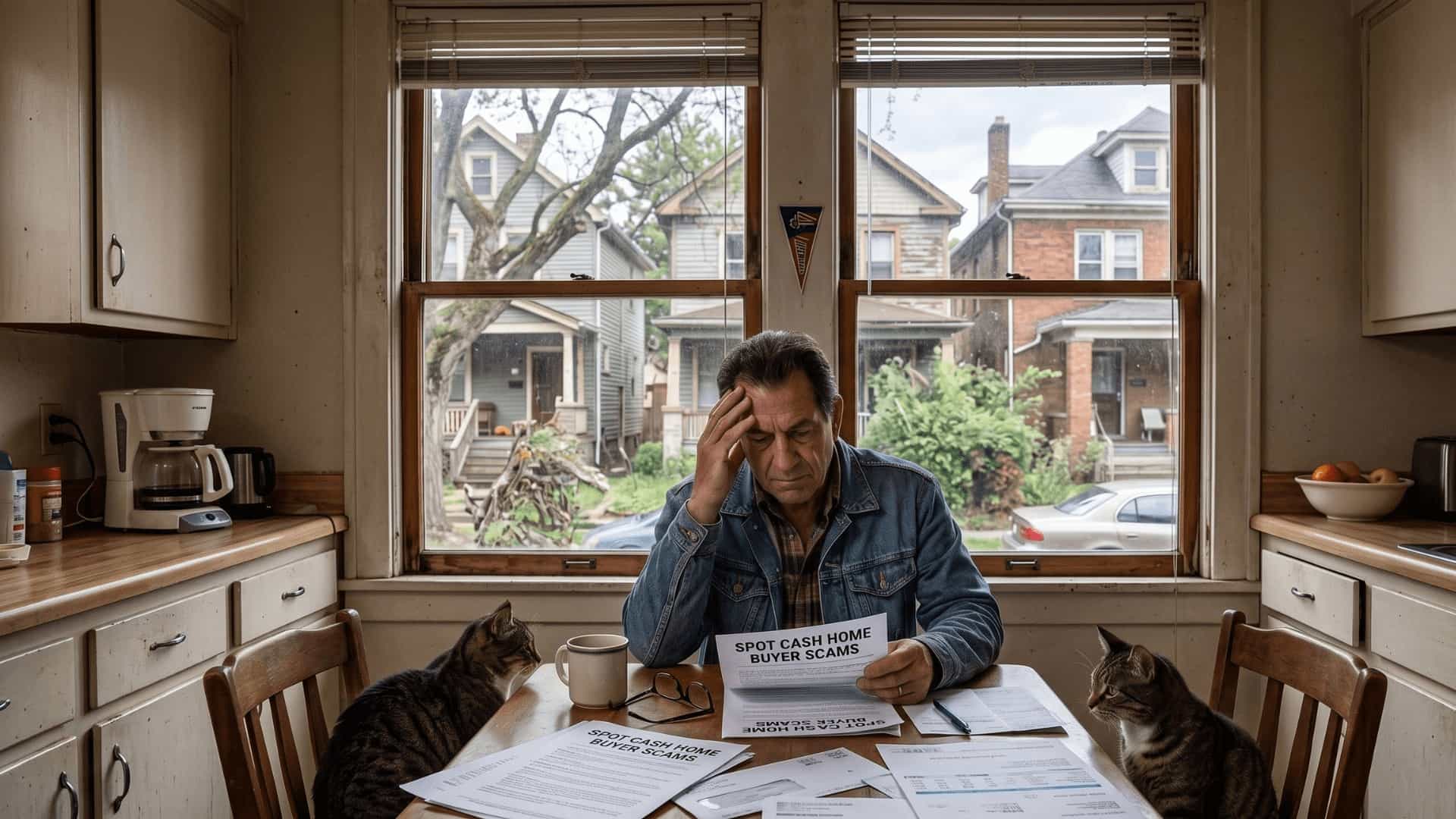
Protecting yourself means verifying the buyer’s legal standing, demanding a bank-authenticated proof of funds, and always closing through an independent, state-licensed title and escrow company never directly with the buyer.
The Federal Trade Commission (FTC) – Consumer Advice on Real Estate Scams has documented a dramatic rise in real estate fraud reports, with losses escalating year over year as inventory shortages push more homeowners toward off-market, direct-sale transactions
What are cash home buyer scams?
Cash home buyer scams are a category of fraudulent or deceptive commercial practices engineered to separate homeowners from their equity. They operate through multiple schemes some illegal, some exploiting legal gray areas and they deliberately target people in distress.
The most common targets are seniors, heirs navigating probate properties, homeowners going through divorce or job relocation, and families facing imminent foreclosure. Urgency and stress are not incidental they’re the environment these operators cultivate.
According to the Federal Trade Commission (FTC), real estate-related fraud cost Americans over $7.9 billion in reported losses in fiscal year 2025, with a median individual loss exceeding $10,000.
5 critical cash buyer red flags to watch for
Learning to recognize these patterns before they escalate is the most direct protection available. Fraudulent operators follow predictable playbooks because the tactics work until sellers know what to look for.
Upfront fees and administrative charges
A legitimate investor will never charge you money to evaluate your home, process an offer, or conduct an appraisal. Full stop.
Scammers exploit unfamiliarity with real estate processes to collect «application fees,» «pre-inspection processing costs,» or «corporate offer handling charges.» These are invented line items with no basis in how professional transactions work.
Refusal to disclose proof of funds
Financial capacity is the foundational premise of a cash sale. If the buyer can’t,or won’t, produce verified Proof of Funds (POF) promptly and transparently, they likely don’t have the money.
Insolvent operators stall because they depend on finding outside financing or assigning the contract before they can actually close. Watch for these specific evasions:
- Claiming «confidentiality restrictions» prevent sharing bank documentation
- Sending screenshots of app balances or PDFs with inconsistent fonts
- Providing letters without an authorized bank officer’s wet signature
- Issuing a POF dated more than 30 days prior
Not all assets are created equal when evaluating a proof of funds. Here’s what counts and what doesn’t:
| Valid Liquid Assets (Acceptable POF) | Not Valid as Immediate POF |
|---|---|
| Checking account balances | Volatile stock/bond portfolios |
| Stable savings account balances | 401(k) or retirement accounts |
| Money market funds | Equity in unsold properties |
| Matured certificates of deposit (CDs) | Pending bonuses, inheritances, or commissions |
High pressure tactics to sign immediately
Manufactured urgency is a core tool in the fraudster’s kit. Artificial deadlines «you’ll lose the house to the bank by Friday if you don’t sign today» are calculated to short-circuit rational analysis.
Legitimate cash home buyers give sellers reasonable time to review documents, consult counsel, and make deliberate decisions. Any buyer who disappears or escalates pressure when you ask for 48 hours to consult a lawyer is telling you everything you need to know.
Absence of a physical property inspection
Professional investors calculate offers based on real repair costs. Those costs directly affect their margins, so any legitimate buyer needs eyes on the property before issuing a firm price.
An immediate, inspection-free offer based solely on Zillow data is almost always an anchoring tactic. Once you sign and pull the house off the market, the buyer sends inspectors to manufacture justification for a dramatic price cut a practice known as gazundering. Sellers often accept the lower number rather than restart the entire sales process.
Unusually low earnest money deposit
The Earnest Money Deposit (EMD) is a buyer’s skin in the game. Professional investors and institutional buyers typically deposit between $1,000 and $10,000 or 1%–3% of the purchase price into a title company’s escrow account.
A fraudulent operator will propose $1 to $500. An EMD that low means the buyer assumes zero financial risk if they walk away. They can abandon the transaction at any stage, for any reason, with no meaningful penalty and frequently do.
How to legally verify a cash home buying company
Due diligence on a buyer is not optional it’s how you separate legitimate cash home buyers from predatory actors. Run this three-level verification protocol before signing anything.
State corporate registration verification
Every company legally operating in the US must be registered and in active good standing with the Secretary of State in the state where the property is located or where the entity was originally formed. Search the state’s business entity registry and confirm:
- The buyer’s exact legal name (typically an LLC or Corporation) matches all contracts
- Status shows «Active» or «Good Standing» not dissolved, suspended, or delinquent
- A physical street address is registered, not just a P.O. box or virtual office
- A valid registered agent is on file to receive legal service
Reputational and complaint history analysis
Search the company’s full legal name on the Better Business Bureau (BBB) – Scam Tracker Tool. Look for:
- An accredited BBB profile with a consistent complaint resolution history
- The company’s phone numbers, addresses, and principals searched against the BBB Scam Tracker for regional fraud reports
- Google reviews with verified purchase patterns (not a sudden burst of five-star reviews with no history)
- A portfolio of recently closed transactions in the same county, verifiable through public records
Authenticated proof of funds verification
Receiving a document claiming fund availability is not the same as verifying it. Use this strict protocol:
- Require a bank-issued letter dated within the last 15–30 days, on official financial institution letterhead
- Confirm the account holder name matches the exact legal entity signing the purchase contract
- Call the bank directly but not using the phone number printed on the letter the buyer provided. Fraudsters print numbers connected to accomplices who impersonate bank officers. Instead, find the bank’s official contact through an independent public registry
- Cross-reference recent closings by asking the buyer for a list of properties they’ve acquired in your county within the last 12 months, then independently verify those title transfers on the County Assessor’s public portal
Structural elements at legitimate Verification of Funds letter:
[OFFICIAL FINANCIAL INSTITUTION LETTERHEAD] [Branch Physical Address Official Registered Phone Number]
Date: [Current Date Maximum 30 Days Old]
To Whom It May Concern:
This letter certifies that [Exact Legal Name of Buyer's LLC/Corporation] maintains active corporate accounts in good standing with this institution since [Year Opened].
As of today's date, the account holder maintains consolidated, unrestricted liquid funds totaling $[Amount in USD] across deposit accounts. These funds are free of liens, holds, or withdrawal restrictions and are available immediately for real estate acquisition.
To independently verify the authenticity of this correspondence, please contact our asset verification division using our institution's official publicly registered contact information.
[Authorized Bank Officer Wet Signature] [Printed Name and Title e.g., Branch Manager / Director of Corporate Relations]
Legal safeguards: The role of independent title and escrow companies
The most powerful protection a homeowner has in any cash transaction is one that fraudulent buyers consistently try to bypass: a state-regulated, independent title and escrow company.
When you’re selling as-is and skipping the traditional agent process, a neutral title company is not a formality it’s the structural foundation that makes the transaction legitimate and enforceable.
Here’s what an independent title and escrow company actually does for you:
- Neutral Custody of Funds (Escrow Account) Once under contract, the buyer must wire both the earnest money deposit and at closing the full purchase price into the title company’s dedicated escrow account.
- Title Search and Legal Clearance Before closing day, the title company conducts a comprehensive search of the county’s public property records documenting the complete chain of ownership.
- Wire Fraud Prevention Real estate wire fraud where criminals intercept email communications to redirect closing funds to fraudulent accounts has caused catastrophic nationwide losses.
| Feature | With Independent Title/Escrow | Direct Buyer Payment (No Title Co.) |
|---|---|---|
| Fund security before closing | ✅ Locked in neutral escrow | ❌ No protection funds controlled by buyer |
| Chain of title verification | ✅ Full historical search | ❌ No lien or claim screening |
| Fraud prevention protocols | ✅ Identity verified, wire protected | ❌ No oversight |
| Legal enforceability | ✅ Official recorded transaction | ❌ Highly vulnerable to disputes |
| Seller liability protection | ✅ Unknown claims surfaced first | ❌ Seller may inherit disputes post-closing |
Any buyer who pushes to close without a title company, offers to pay cash directly, or frames the escrow step as «unnecessary» is describing a transaction with no legal protection for you. Treat that proposal as disqualifying.
What to do if you encounter a predatory cash buyer
The moment behavior crosses from aggressive sales tactics into clear red flag territory, the sequence matters. Here’s how to protect yourself:
1. Stop all direct communication immediately
Cease all calls, texts, and emails with the suspect party. Responding even to decline confirms an active line and typically triggers automated escalation from these networks.
2. Do not sign or return any documents
If any contracts, LOIs (Letters of Intent), or authorization forms have been sent but not yet signed, do not return them. Unsigned documents create no legal obligation.
3. Launch an independent evaluation
o get a clear, unbiased read on your property’s value, initiate an independent evaluation process through a certified appraiser or a state-licensed real estate agent operating in a fiduciary capacity for you not the buyer. This gives you market-grounded data to compare against any offer you’ve received.
4. Consult a real estate attorney if you’ve already signed
If you’ve already signed a purchase agreement or any preliminary contract, retain a real estate attorney immediately. An attorney can review exit clauses, identify rescission rights, and pursue legal dissolution of predatory agreements often without financial penalty to the seller, especially in states with active wholesaling disclosure laws.
5. File reports with the appropriate US authorities
Documenting these operations supports investigations that protect other homeowners. File reports with:
- Federal Trade Commission (FTC): Submit at reportfraud.ftc.gov with full details of the interaction, all documents, and contact information
- Better Business Bureau (BBB): Report the scam at the BBB Scam Tracker to publicly flag the operator’s phone numbers, tactics, and regional activity
- State Attorney General’s Office: File a consumer protection complaint with your state AG’s division, including copies of all contracts and correspondence
- FBI Internet Crime Complaint Center (IC3): If the scam involved email impersonation, wire fraud, or identity theft, file at www.ic3.gov
2026 US legislative updates: Wholesaling protections for sellers
The regulatory landscape has shifted meaningfully in sellers’ favor. Multiple state legislatures enacted reforms in 2025–2026 specifically targeting the unauthorized wholesaling practices that gave predatory «cash buyers» their primary legal cover.
| State | Law Status (2025–2026) | Key Seller Protections |
|---|---|---|
| Oregon | In effect since July 1, 2025 | Wholesalers must register with the Oregon Real Estate Agency or hold an active broker license. Written disclosure of assignment intent required in all ads and contracts. |
| Ohio | In effect since March 2, 2026 (SB 155) | Written disclosure that the buyer is acting as an intermediary not representing the seller is mandatory. Seller may cancel anytime before escrow closes if disclosure is omitted; full deposit returned within 30 days. |
| Oklahoma | In effect since November 1, 2025 (SB 1075) | Wholesalers must advise sellers in writing to seek legal counsel, disclose assignment intent in detail, and cannot publicly advertise properties they don’t legally own. Sellers hold a 2-business-day right of revocation. |
| Connecticut | Effective July 1, 2026 (HB 7287) | Mandatory wholesaler registration with the Department of Consumer Protection. 3-business-day rescission window for sellers. Close deadlines capped at 90 days to prevent indefinite property holds. |
| Illinois | Active with strict enforcement | Wholesalers may execute only one contract assignment per 12 months without a real estate license. Two or more annual transactions without a license is classified as a Class A misdemeanor. |
| Maryland | In effect since October 1, 2025 (HB 124 / SB 160) | Wholesalers must disclose assignment intent and the estimated assignment fee in writing to the seller prior to signing, and must clarify they may not be able to convey title directly at closing. |
If you’re in one of these states and a buyer failed to make legally required disclosures, you may already have the right to cancel the contract and recover your deposit regardless of what the contract says. A real estate attorney can confirm your specific rescission rights under state law.