
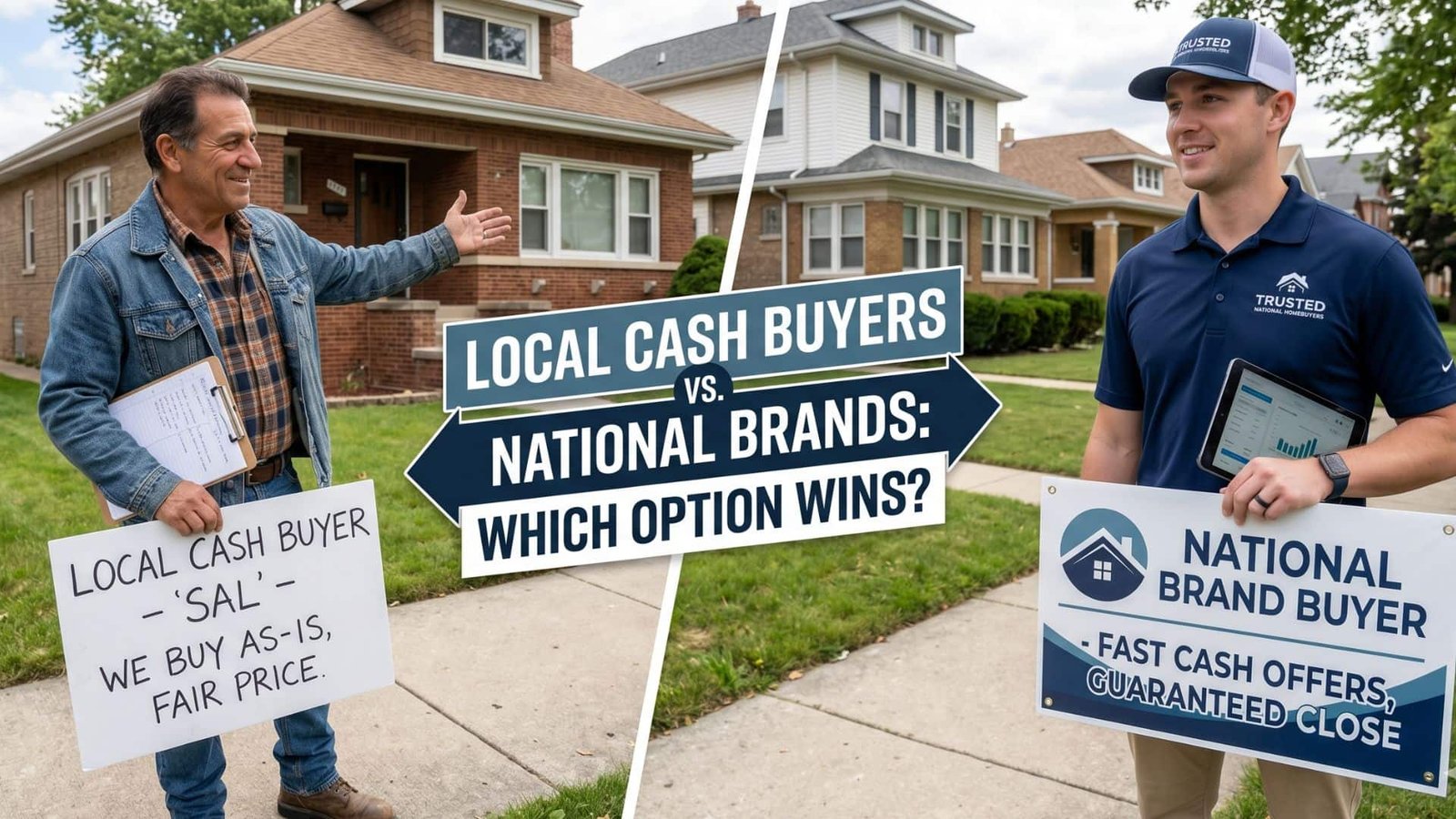
The off-market real estate industry has never been more crowded — or more confusing. TV commercials promise fast cash. Yard signs claim «We Buy Any House.» And a growing wave of tech-powered platforms now competes with your neighbor who flips properties on the side.
So when you need to sell fast, which option actually puts more money in your pocket — a recognizable national brand or a local independent investor operating in your own zip code?
This independent, data-driven comparison breaks down both models across the metrics that matter most: net payout, closing speed, flexibility, and transaction safety. No affiliate deals. No sponsored rankings. Just the numbers.
Local vs. National Cash Buyers at a Glance
Best cash home buyers for distressed or complex properties are almost always local independent investors. They operate with lower overhead than national franchises, which means they can offer higher purchase prices — often $20,000 to $30,000 more on a $300,000 ARV property. National brands and iBuyers are better suited to move-in-ready homes in large metro areas. For any property with structural damage, legal complications, or tenant issues, a vetted local buyer will outperform every time.
The Landscape of Off-Market Real Estate Investing
The U.S. housing market in 2026 is operating under sustained macroeconomic pressure. Home price growth has moderated to between 2% and 4% nationally, while 30-year fixed mortgage rates have stabilized in the 5.75%–6.75% range — a level that continues to price out a large segment of conventional buyers.
First-time buyers now represent just 21%–28% of all transactions, with the median buyer age climbing to 35–40 years old. Affordability constraints are forcing more financed deals to collapse before closing, which is one reason all-cash transactions now account for roughly 30% of total market activity.
[INSERT INFOGRAPHIC: U.S. Cash Transaction Share vs. Interest Rate Trends, 2022–2026]
Against this backdrop, homeowners facing financial pressure — or holding properties with significant physical deterioration or legal complications — are turning in growing numbers to selling property off-market to avoid the traditional MLS process, which averages more than 41 days just to execute a purchase contract.
By going direct to best cash home buyers, sellers eliminate financing contingencies, bank appraisals, and costly pre-sale repairs — compressing closing timelines from months to days.
But the success of this exit strategy hinges on a single, critical decision: national corporate brand, or local independent investor?
National Cash Buying Brands: Scalability, Systems, and Rules
National cash buying companies operate on a foundation of standardized processes, predictive technology, and economies of scale. Two dominant models exist within this space.
iBuyers (Tech-Platform Buyers)
Companies like Opendoor and Offerpad fall into this category. Their model relies on algorithmic pricing and digital transaction management.
Key characteristics:
- Target market: Move-in-ready or lightly used homes in established metro areas
- Initial offers: Typically near fair market value — but this is deceptive
- Service fee: A fixed charge of 5%–7% applied after acceptance
- Post-inspection deductions: Substantial credits are routinely demanded after physical walkthroughs, eroding the initial offer
- Speed: Relatively fast, but gated by corporate approval layers
National Franchise Networks
Companies like HomeVestors (We Buy Ugly Houses) operate through franchisee networks. Unlike iBuyers, they explicitly target distressed and «ugly» properties.
Key characteristics:
- Pricing formula: Strictly apply standardized corporate formulas, offering 50%–65% of After-Repair Value (ARV) after deducting repairs
- Overhead burden: National TV advertising campaigns, corporate support staff, and ongoing royalty payments to the franchisor all inflate their cost structure — and those costs flow directly into lower offers for sellers
- Negotiation flexibility: Essentially zero; local franchisees are bound by regional committee guidelines
- Earnest money advances: Rare to non-existent in the franchise model
Our national cash buyers guide details exactly how these corporate pricing algorithms work — and where they consistently leave money on the table for the seller.
The core problem with national brands: Their cost structures — TV spots, franchisee royalties, corporate overhead — are not absorbed by the company. They are priced into your offer as a lower payout. You are effectively subsidizing their marketing budget.
[INSERT INFOGRAPHIC: National Brand Cost Structure — Where the Discount Goes]
Local Real Estate Investors: Flexibility, Local Market Knowledge, and Direct Ties
Independent local investors operate from a fundamentally different vantage point — and that difference translates directly to better terms for the seller.
Hyperlocal Market Intelligence
Because local buyers live and work in the same neighborhoods they invest in, they interpret qualitative factors that no algorithm can capture:
- Proximity to specific school districts
- Block-by-block urban revitalization trends
- Emerging commercial corridors that signal appreciation
- Neighborhood comps that only a boots-on-the-ground investor would know
This depth of knowledge reduces the risk premium they need to build into their offers, making their bids more competitive than corporate models.
A Buy-and-Hold Mindset Changes the Math
A meaningful share of independent local investors are not fix-and-flip operators racing to exit in 90 days. Many are long-term rental portfolio builders — and this fundamentally changes how they calculate an acceptable purchase price.
Rather than needing to sell quickly to cover financing costs, a buy-and-hold investor amortizes their acquisition cost over decades, not months. They analyze deals using benchmarks like:
- The 1% Rule: Monthly rent should equal at least 1% of the total purchase price to ensure operational profitability
- The 0.5% Rule: Applied in high-density, higher-priced markets where absolute rent levels still produce viable cash flow
- The 2% Rule: Used in high-yield, low-acquisition-cost markets to identify exceptional deals
Many of these investors manage their rental assets under the professional standards established by the National Association of Residential Property Managers (NARPM), targeting consistent positive cash flow typically exceeding $200/month after deducting principal, interest, taxes, insurance, and reserves (PITI).
The practical result for you as a seller: a patient, long-term buyer can offer you a higher price precisely because they are not racing the clock.
Contractual Flexibility That Corporate Buyers Can’t Match
Without corporate committees or rigid approval chains, a local investor can structure terms around your actual situation:
- Cash advances at signing — up to $10,000 before the formal closing date
- Post-closing occupancy agreements — allowing you to remain in the property after signing while you arrange your next move
- Tenant-in-place purchases — buying without requiring you to evict current renters
- Probate and estate sales — working directly with estate attorneys to navigate complex title situations
- Distressed title resolution — coordinating with local title companies to clear liens, HOA judgments, or tax delinquencies
Comparing Payouts: Who Offers More Money for Distressed Property?
The industry standard for pricing a distressed property acquisition is the 70% Rule — a financial ceiling that defines the maximum any investor should pay:
Maximum Allowable Offer (MAO)=(ARV×0.70)−Repair Costs
The 30% margin below ARV is not profit — it’s a composite buffer that must absorb:
- Acquisition and closing costs: Title insurance, notary fees, recording charges, escrow
- Financing costs: Bridge loan or private capital interest during the hold period
- Holding costs: Property taxes, hazard insurance, HOA fees, and utilities while vacant
- Resale costs: Buyer’s and seller’s agent commissions (5%–6%) plus closing costs at resale
- Risk and contingency buffer: Unforeseen structural issues or market softening before exit
After all of these are deducted, the investor’s true net profit margin is typically only 10%–15% of the final resale price.
Side-by-Side Transaction Comparison
The table below models a real transaction on a property with an estimated ARV of $300,000 requiring $60,000 in certified repairs.
[INSERT INFOGRAPHIC: Visual Deal Breakdown — National vs. Local on a $300K ARV Home]
| Metric | National Franchise (e.g., HomeVestors) | Local Independent Investor (e.g., Easy Sell) |
|---|---|---|
| % of ARV Applied | 50%–65% (inflated by network overhead) | 60%–75% (lean cost structure) |
| Purchase Offer Calculation | $120,000 (60% × $300K − $60K repairs) | $150,000 (70% × $300K − $60K repairs) |
| Closing Costs Covered | Yes, by the franchise | Yes, by the investor |
| Seller Commissions | $0 | $0 |
| Advertising/Royalty Costs | Baked into lower offer | $0 — no franchise fees |
| Cash Advance at Signing | Not available / extremely rare | Up to $10,000 available |
| Guaranteed Closing Timeline | 2–4 weeks (pending title validation) | 7 business days after escrow confirmation |
| Decision Authority | Regional committees and corporate guidelines | Direct — investor decides alone |
| Net Payout to Seller | $120,000 | $150,000 |
The delta is $30,000 on this single transaction — in favor of the local independent buyer.
That gap is not a coincidence. It is the mathematical consequence of two entirely different cost structures.
Safety and Security: Escrow Practices and Proof of Funds
Speed and higher offers mean nothing if the buyer can’t close — or worse, if they are running a scam. Here is exactly how to verify legitimate cash home buyers before you sign anything.
Step 1: Demand Proof of Funds Immediately
Any serious cash buyer must provide documentation of liquid funds — a certified bank letter or an official account statement from a regulated financial institution, issued within the last 48 hours, showing the full purchase amount is available.
Warning signs of a fake cash buyer:
- Delays or excuses around providing proof of funds
- Offers that seem unusually high compared to others
- Pressure to sign a contract before any documentation is shared
Many operators who drag their feet on proof of funds are not buyers at all — they are wholesalers attempting to tie up your property under an option contract and then assign it to a real buyer. If they can’t find one, they walk. You’ve wasted weeks.
Step 2: Require a Licensed Escrow or Title Company
Every legitimate cash transaction must flow through a licensed escrow agent or independent title company regulated under your state’s insurance laws.
In a properly structured transaction:
- The buyer deposits funds directly into the escrow account — not to you or any intermediary
- The title company conducts a full title search, clearing any liens, HOA judgments, or tax delinquencies
- Funds are only released when title transfers cleanly at closing
No legitimate buyer will ask you to bypass escrow.
Homeowners Facing Foreclosure: Know Your Rights First
If financial hardship is driving your decision to sell, federal law gives you more time and more options than you may realize.
Under CFPB and HUD regulations, your mortgage servicer is legally required to:
- Provide written information on all loss mitigation options within 45 days of your first missed payment
- Refrain from initiating any foreclosure action until you are at least 120 days past due
Before accepting any cash offer under duress, review the free resources available through the HUD Guide to Avoiding Foreclosure and Scams, which outlines every federal loss mitigation option available to you at no cost.
Retention options (stay in your home):
- Deferment — Unpaid balance moves to the end of your loan; regular payments resume immediately
- Repayment Plan — Spread arrears over several months added to your regular payment
- Forbearance — Temporary pause or reduction in monthly payments during hardship
- Loan Modification — Permanent restructuring of rate, term, or principal balance
- FHA Partial Claim — Available for FHA loans 4–12 months delinquent; a zero-interest government advance cures the arrears
Exit options (leave the home without foreclosure):
- Pre-Foreclosure Sale — Lender-approved sale at market value within a negotiated window (3–5 months)
- Short Sale — Sell for less than the outstanding mortgage balance; lender absorbs the loss
- Deed-in-Lieu — Voluntarily transfer title to the lender in exchange for full debt forgiveness
A critical warning from HUD and CFPB: Any individual or company that charges upfront fees to negotiate your mortgage or stop a foreclosure is, by legal definition, fraudulent. Government-certified loss mitigation counseling is always free.
Red Flags That Signal a Scam
Stop any negotiation immediately if a buyer:
- Asks you to sign over your deed before the formal closing date
- Suggests you redirect mortgage payments to a third party
- Imposes an artificially urgent deadline without time for legal review
- Proposes a loan assumption without a formal release from your original lender
Decision Framework: How to Select the Ideal Investor for Your Market
The right choice is not about which brand runs the most TV commercials. It is about matching your property’s specific profile and your personal circumstances to the buyer model that is structurally best positioned to serve them.
Use this decision matrix to identify your optimal exit path.
[INSERT INFOGRAPHIC: Decision Tree — Which Type of Cash Buyer Is Right for Your Property?]
| Property Condition & Seller Context | Recommended Option | Why |
|---|---|---|
| Move-in ready, no structural issues, large metro area | iBuyer (National) | Maximizes liquidity without listing commissions; predictable timeline suits coordinated purchases |
| Major structural damage — fire, mold, foundation failure | Local Independent Investor | iBuyer algorithms auto-reject these; local investors have direct contractor relationships and can hold long-term |
| Out-of-state owner or rural/semi-rural market | Local Independent Investor | National platforms don’t cover secondary markets; only local investors can physically evaluate the asset |
| Tax liens, active judgments, or probate/estate complications | Local Independent Investor | Corporate buyers lack the legal flexibility; local investors work directly with estate attorneys and title companies |
| Property occupied by difficult tenants or below-market leases | Local Independent Investor | Nationals require vacant delivery; a buy-and-hold local investor assumes the tenancy and manages the transition |
| Foreclosure auction in fewer than 14 days | Local Independent Investor | Offers the fastest verifiable close — guaranteed 7 business days from escrow confirmation, stopping the auction |
The Bottom Line
National brands deliver acceptable outcomes for straightforward, qualifying properties in large cities where their technology and scale provide genuine operational advantages.
But for the majority of homeowners navigating complex circumstances — distressed properties, legal complications, rural locations, or urgent timelines — a vetted local investor consistently delivers a higher net payout, faster closing, and more human flexibility than any corporate alternative can match.
The $30,000 spread documented in the transaction table above is not an outlier. It is the structural, predictable consequence of a leaner cost model flowing directly back to you.
This article is provided for informational purposes only and does not constitute legal or financial advice. Homeowners facing foreclosure are strongly encouraged to consult a HUD-certified housing counselor bbefore accepting any off-market purchase offer.